
Dungeon Geomorphs and Outdoor Geomorphs in Greyhawk
Introduction
Each of the original editions of the Dungeon Geomorphs came with sample encounters, just like the later compilation of sets one to three. The original sample encounters offer insight into Gygax's creative process, and may be drawn directly from various Castle Greyhawk encounters. Similarly, the Walled City Geomorphs offer general advice to DMs on how to create cities, as well as specific details about how Gygax and Kuntz used color on map keys and legends to help make maps more usable. In addition, the Walled City geomorphs explicitly mention various Greyhawk City features (Lake of Unknown Depths, the Almshouse of the Brotherhood of the Blinding Light, etc.).
- Dungeon Geomorphs: Set One Basic Dungeon (1976)
- Dungeon Geomorphs: Set Two Caves & Caverns (1976)
- Dungeon Geomorphs: Set Three Lower Dungeons (1976)
- Dungeon Geomorphs: Set One to Three: Basic Dungeons, Caves & Caverns, Lower Dungeons (1980, 1981)
- Outdoor Geomorphs: Set One Walled City (1977)
For an example of how a dungeon level could be constructed using the geomorphic pieces, check out my Dungeon Level 3 in my version of Greyhawk Castle.
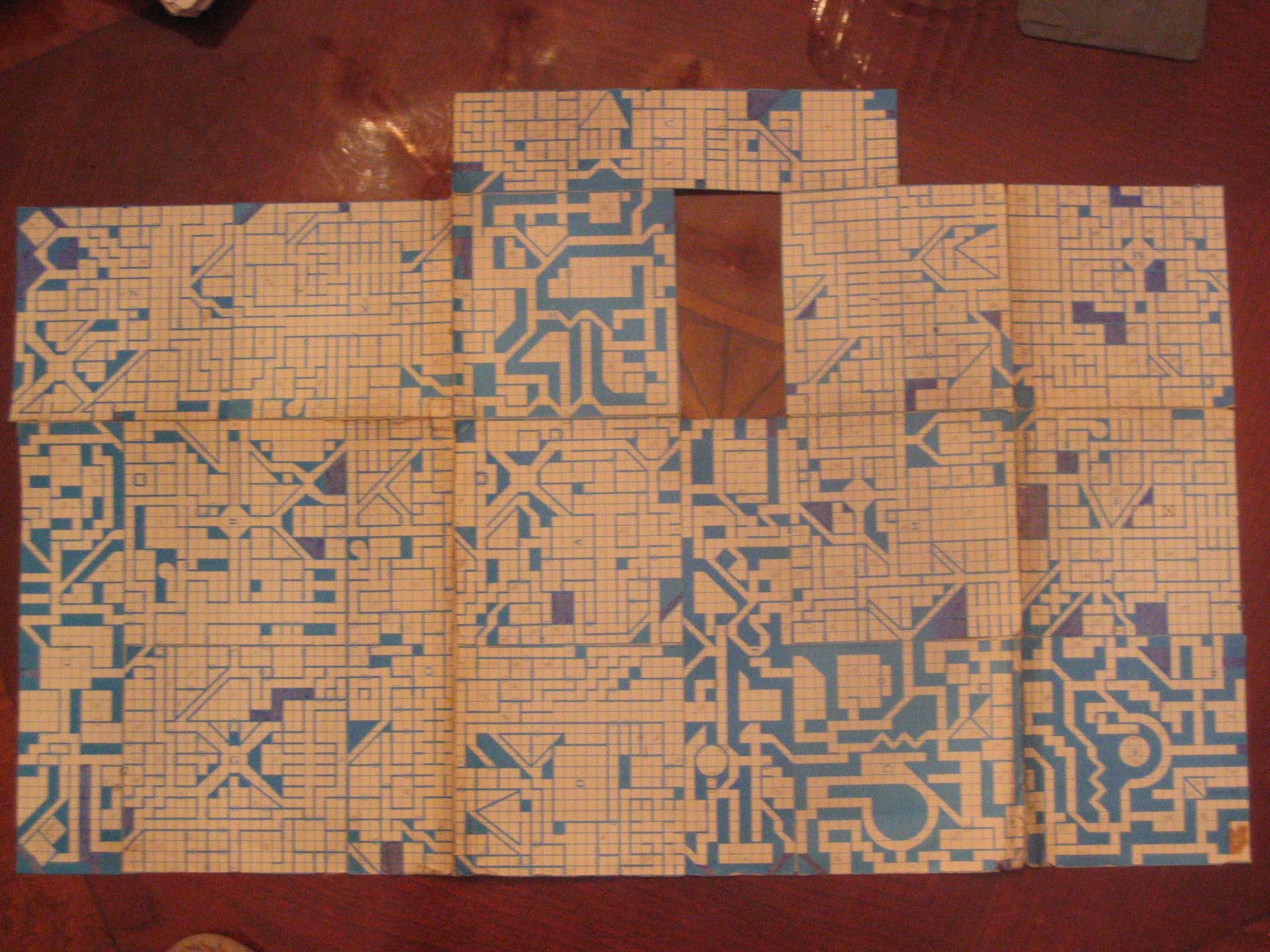
Dungeon Geomorphs: Set One Basic Dungeon
ENCOUNTER KEY EXAMPLE
1. A rudely furnished room with an old holy man (lawful/good) who has sworn a vow of silence. He will not fight if attacked. He takes only 2 hit points. There is a pottery flask containing his drinking water in one corner; a small container near his pallet has a handful of lentils (all of his food); there are some rags hanging from a nail in the wall, and a wooden begging bowl on a rough wooded table near the door holds 1 silver piece and 3 coppers. If he is impolitely treated or his room is searched he will do nothing, but he will never aid the offenders. If so much as a single copper piece is dropped in his bowl, he will make a holy sign which will add 1 hit point permanently to all party members. After doing the latter, he will disappear when the party leaves, and he will be replaced by 1A.
a. An insane fiend conforming generally to the description of 1. above. He will say nothing until a party is in his abode, but will then attack with two hidden daggers. He takes 12 hit points, with an armor class equal to 5 due to his 18 dexterity. He has no treasure to begin with…2. A seemingly empty room which contains a gold tube worth 230 gold pieces. It is invisible. Inside the tube is a map to stairway #7, indicating that it leads directly to the 4th level down. If the room is searched, there is a cumulative change of 2% per person per turn of general searching that it will be stumbled upon.
3. 4 LARGE SPIDERS, H.P.: 6, 5, 3, 2. They tend to lurk directly above the entryway and have a 50% chance of surprising any party entering. Only the largest has normal poison, and if the other 3 bite, the victim has +4 on his saving throw. Bite damage is 1. If the room is searched, it will be noted that there are heavy cobwebs in the corners. In the SW corner they conceal a small space, and in that space is the skeleton of a man---including a suit of plate mail, a lantern, 2 flasks of oil, 4 vials of holy water, a dagger, a sword, and a mace. There are 167 silver pieces in a rotting leather bag at the far end of the space. All other possessions of the dead fighter have rotted.
4. Steps down to the 2nd level (geomorph E, central portion).
5. False door which fires an arrow directly out when it is opened. The arrow is magical (+1), and if it fails to hit it will be usable. After the first magic arrow, it wil fire only non-magic ones which will break whether or not they hit.
Dungeon Geomorphs Set Two
ENCOUNTER KEY EXAMPLE
13A. The Crystal Cavern---an area where stalagmites, stalactites, and other such
subterranean formations are in profusion. Some of them will glisten and
glimmer, showing themselves to be made of precious metals woth thousands of
gold pieces (18-2,000 gold piece value crystal or precious quartz stalgtites).
Humans are not the only ones who are dazzled by such wealth and beauty, for
ropers consider it to be their gem garden. There will always be 2-5 ropers
around admiring it. Also, 1-4 additional ropers will come to it in 1-6 melee
rounds if they happen to hear fighting.13B. A party of thieves (levels: 8, 6, 4; HP: 25, 18, 12) waiting to fleece adventurers.
They will attempt to hide in shadows and steal valuables from players as they
pass. They will only initiate combat if the adventurers appear to be damaged
and treasure-laden. The leader has a +2 neutral “Charm Person” sword (3
intelligence, 12 ego) and 1-8 gems (worth 500 gold pieces each). The sixth level
thief has a +1 dagger and 100 platinum pieces. The fourth level flunkie has 50
gold pieces on his person.13C. The Mirror Pool---a glimmering 6’ by 3’ mirror pool, contained within a sunken
crystal basin. Adventurers may step into the pool and suddenly find themselves
in a 60’ by 60’ room with an enraged efreet. They may step back out as easily as
they open doors. The efreet wears four pieces of jewelry worth only 50 gold
pieces each. Once encountered, the efreet will fight until defeated (37 HP) or
until the basin is broken (to do so, a +2 or better weapon must be used). When
the basin in broken, check on a six-sided die for the reaction of the efreet: 1---
Efreet is insane from being cooped up so long, and will attack until killed; 2---
Efreet rushes off to avenge himself, leaving his rescuers behind; 3 and 4---Efreet
thanks group, gives them his jewelry, and then leaves; 5---Efreet will aid
adventurers on 1-4 adventures (secret determination of time) and then vanish;
6—-Efreet is so thankful that he will serve his rescuer for 1001 days.13D. The Pile of Gold. Upon entering the area, the party will notice that there has
been a fight. First, they will see a dragon skeleton and human remains. Then
they will notice that there is still a large pile of gold left by whomever looted the
room. As they approach the pile it comes to life, suprising them all, and attacks!
It is a metal creature (the Aurotyugh) and so has some suprising abilities. It
takes 18 hit dice (88 HP) and is Armor Class 3. It does 3-18 HP every time it hits,
and its special attack abilitity is that it softens hard things. Every time it hits, its
opponent goes down one Armor Class (so +2 armor becomes +1, or a Wyvern
with Armor Cass 3 goes to 4). This creature is worth 25,000 GP---the teeth are
made of diamonds and if carefully and time-consumingly taken out are worth
30,000 gold pieces (but only 5,000 gold pieces if hastily pulled).
Dungeon Geomorphs Set Three
ENCOUNTER KEY EXAMPLE
7A. One huge Black Pudding, H.P.: 50. This monster is always very hungry, and it
will pursue relentlessly as long as the party is in the room complex. Amidst the
mass of junk in its lair is a bag of devouring with 7,000 gold pieces therein which it uses to attract prey.
7B. The Altar of the demon Sha-Hec'urah, set with fifty base 100 GP gems. There is a
pit trap (10' deep, with six poisoned spikes) before it, with the cover trip
mechanism to lock, unlock, or spring it hidden in a recess in a wall at the spot
marked X. Touching the altar automatically alters 7C (below).
7C. An evil lama and curate (H.P.: 26, 21; A.C.: 0, 2; S.A.: Lama has snake staff and
normal mace, curate has +1 mace) who serve the altar. With them is the "Arm of
Sha-Hec'urah," a creature which appears to be a troll, but which strikes as a nine-
die monster and causes only a loss of strength at 1 point per hit. Strength loss
lasts for 2-12 turns, except on a roll of 20, in which case the loss in permanent
unless a cure disease spell is cast upon the victim within 24 hours of the hit. The
"Arm" wears an amulet which gives him this weakening ability. If he is slain the
amulet may be worn by any player character, and his scoring a hit by touch will
enable the strength loss to take place; the wearer loses 5 points permanently from
charisma and will become more and more chaotically evil until becoming the
new "Arm." The "Arm of Sha-Hec'urah": H.P.: 43; A.C.: -2 (due to the amulet).
The "Arm" will call if below 20 H.P., and if the demon is thus summoned, there is
a 10% chance it will come.
7D. 6 GNOLLS, H.P.: 13, 11, 11, 10, 9, 7. These are the guards for 7E, and as soon as
they see any tresspasser enter their area two will run for help, three will attempt
to hold off the enemy for a moment, and the last will slip to the alcove in the
passage leading out. As he hears his three rear-guards shouting, he will pull the
chain which opens the bars of the cages set high in the walls of the chamber they
are deserting, freeing 2 GARGOYLES (H.P.: 20, 17). In the far corner of the
chamber are 3 magic arrows (+1) and 670 GP belonging to the gnolls.
7E. 2 STONE GIANTS, H.P.: 44, 36. These two are quite clever for their kind, having
amassed a treasure of 10,400 CP, 4,500 SP, 1,980 EP, and 625 GP stored in two
large chests with no locks or protection. They have hidden a potion of hill giant
strength in a bucket of water on their table. The "water" in their bucket is actually
a powerful delusive agent, and if it is touched it will cause delusions that the
bucket has disappeared. There are ten base 100 GP gems hidden in the larger
giant's club handle.
Dungeon Geomorphs: Set One to Three: Basic Dungeons, Caves & Caverns, Lower Dungeons
Note that the encounters presented in the compiled set are similar to, but somewhat different than those from Set One. While the text has been edited and cleaned up, some noteworthy details differ from the original version. The sample encounters are identical in the first through third printings of the compiled geomorphs.
SAMPLE ENCOUNTER KEY
1. This is a sparsely furnished room with an old holy man (Lawful) who has sworn a vow of silence. He has 2 hp, and will not fight if attacked. There is a ceramic flask in one corner which contains his drinking water; a small container near his pallet holds all of his food (greens); there are some rags hanging on one wall, and a wooden begging bowl sits on a rough table near the door. The bowl contains 3 cp and 1 sp. If he is impolitely treated or if the room is searched, he will not react but he will not help the party. If even a single copper piece is dropped in his bowl, he will make a holy sign which will permanently add 1 hp to each party member! If he does this, he will disappear after the party leaves, to be replaced by 1A (below).
1A. This is an insane fiend who appears identical to #1 (above). He will not speak, but will attack a party after they have entered, using two hidden daggers. He takes 12 hp, AC 5 (due to high dexterity), and has no treasure.2. This seemingly empty room contains an invisible gold tube worth 250 gold pieces. Inside the tube is a map to stairway #16, indicating that it leads down to the 3rd level. If the room is searched, there is a 2% change per person (cumulative) per turn that it will be found.
3. Empty room.
4. 2 Giant Black Widow Spiders (AC 6, MV 60' (10') or 120' (20') in web, HD 3*, hp 12, 9, # AT 1, D 2-12 plus poison, ML 6, Save F: 2) often lurk above the entrance, and have a 50% chance of surprising anyone entering. Only the larger has normal poison; a person bitten by the other gains +2 on their saving throw versus poison. If the room is searched, heavy cobwebs will be seen in the corners. In the eastern corner, the webs conceal a pit, in which is a skeleton, a rusty suit of plate mail, a lantern, 2 flasks of oil, 2 vials of holy water, a dagger, a sword, and a mace. There are 167 sp in a rotting leather bag underneath all the other items.
5. Steps down to level 2 (E III, central area -- see map).
6. False door: this, when opened, fires a magical (+1) arrow (needs a '9' to hit AC 2). If it misses, it will be usable by the party. After the first (magic) arrow, the 'door' wil only fire non-magic arrows, which will break if they miss.
7. Empty room.
8. Empty room.
Outdoor Geomorphs: Set One Walled City

THE CITY OR TOWN
History: It is always a good idea to have at least a brief history of the city or town sketched out beforehand. You may draw upon the configuration you have made in order to get some ideas, of course, and the history should always relate to the overall scheme for your campaign.
Divisions: Cities should have sectors which indicate the general nature of each, i.e. a Thieves Quarter, a Peasants Market, a New Quarter, a Foreign Section, a Temple Block, etc. IF you ahve formed a permanent city map, you might wish to note divisional names upon the map.
Government: The headquarters of the ruler or rulers of the city or town should be located near the center part of the place or perhaps in a castle or fortress elsewhere. It is very important to decide just what form of government the city has and what characteristics (including things like greed factors, sanity, etc.) the ruler or rulers have.
Military Force: The military force of the place will typically consist of a permanent garrison of soldiers, an elite guard, a city watch (veteran militia), and militia reserves. Most mercenaries will be found in the guard. A despot or tyrant will seldom have anything other than mercenary forces. The location of all such forces, as well as details of their leaders, numbers, arms, etc. are important.
Occuptaions: The occupants of various buildings will be drawn from the races and character classes and from the following list of typical occupations for the inhabitants of a typical medieval fantasy city. Occupations shown do not include some of the character classes. These occupations are also used as a base from which the city traffic routes can be named. For example, on "Herbal Lane" you would locate alchemists, apothecaries, herbalists, etc. Of course, one or more other types of shops, stores, inns, or taverns can also be located along the route. At one end several fortune tellers might be found, while at the upper end some physicians, chuirgeons, leeches, and barbers might be found---perhaps where the Lane T's at Medicine Row. Group similar occupations together, and keep those which are generally unsavory in the same locale, i.e. in the Thieves' Quarter you will find the Thieves Guild, the Assassins' Guild, Pimp Passage, Drunkards' Walk, Avenue of Beggars, Whore Street, Gamblers' Row, and the lower end of Currency Avenue where many money lenders can be found.
Some of the occupations shown will be for persons who do not normally reside in a town or city. Such individuals would be located during the day in the markets (drovers, farmers, millers, etc.) or in the inns and taverns at any time.
TYPICAL OCCUPATIONS
| alchemist | carter | emblazoner | hunter | money changer | seamstress |
| apothecary | cartographer | engineer | innkeeper | money lender | ship chandler |
| architect | chandler | escourt (guard) | ironmonger | net maker | silversmith |
| armorer | charcoal burner | falconer | jeweler | painter | sign painter |
| assassin | chair bearer | farmer | jongleur | perfumer | stone carver |
| astrologist | cheese maker | fisherman | kennel keeper | physican | sweeper |
| baker | chimney sweep | fish monger | laborer | pimp | swordsmith |
| banker | chuirgeon | fletcher | lamp maker | pitch maker | tailor |
| barber | clerk | fortune teller | launderer | player | tanner |
| bargeman | clothier | fowler | leech | playwright | tavern keeper |
| basket maker | cobbler | freighter | limner | poet | teamster |
| bearward | confectioner | fuller | linkboy | porter | thatcher |
| beggar | cooper | furrier | liveryman | potter | thief |
| blacksmith | coppersmith | gambler | locksmith | rat catcher | tinker |
| boatwright | courtesan | goldsmith | man-at-arms | roofer | tinsmith |
| bowyer | crier | grocer | mason | rope maker | trader |
| box maker | crocker | grover | mercenary | rug maker | trapper |
| brewer | dancer | harness maker | merchant | saddler | upholsterer |
| brick maker | draper | hatter | midwife | sail maker | vintner |
| butcher | drover | herbalist | miller | sawyer | wainwright |
| cabinet maker | dyer | herdsman | milner | scholar | woodcutter |
| carpenter | embalmer | hostelry | minstrel | scrivener | wood worker |
| zoo keeper |
City Locales: In addition to the major divisions of a town or city already mentioned (quarters, sections, blocks), there are a number of other useful locations and building types to aid in the development of a community with character. Likewise, the variations of names for traffic routes and assocations/groups are most useful. Let us assume that at the end of Gambler's Row is a court (Money Changer's Court) where the Usurer's Union building is. Just up Pennyless Walk is the Almshouse of the Brothers of the Blinding Light.
CITY LOCALES
Traffic Routes
| alley | lane | pike | street |
| avenue | mews | place | thoroughfare |
| circle | path | road | walk |
| crescent | passage | row | way |
Open Places
| bazaar | fair | mart | square |
| common | garden | park | triangle |
| court | mall | plaza | yard |
Buildings and Constructions
| armory | hall | mansion | tavern |
| barracks | hospice | palace | theatre |
| booth | hospital | quay | tower |
| castle | hostel | salon | villa |
| citadel | inn | shop | warehouse |
| commissary | keep | smithy | wharf |
| dock | lodge | stable | |
| depot | manor | store |
Religious Buildings
| abbey | chapel | friary | polystary |
| almshouse | church | hermitage | priory |
| cathedral | cloister | manse | shrine |
| chantry | convent | monastery | temple |
Associations and Groups
| academy | brotherhood | fraternity | school |
| alliance | caste | guild | society |
| association | college | league | syndicate |
| band | fellowship | order | union |
KEYING YOUR CITY
It is quite easy to alter the traffic routes or constructions of your city---either by marking directly on the geomorphs or by using grease pencils on a plastic overlay of some sort. Whether or not you wish to do so is entirely up to you, but in any case it will be necessary for you to name the various traffic routes in the city, the open places, the major edifices, and tell who or what inhabits at least some of the buildings therein. It is best to be able to write the names of most of these things directly upon the geomorphs which form the city, but it is possible to number them, and use a key---a numbered sheet with the names and other information written thereon to correspond to the map numbers.
In similar fashion, each building should be colored and/or numbered. You might wish to shade all evil religious buildings purple, for example, with a dark hue for lawful evil, and a tint for chaotic evil. Banks, money changers, and money lenders could be colored yellow; inns might be done in green, places where arms and armor are sold could be done in gray, and so on. After so coloring, those places which are important must also be numbered and keyed. For example:
-
Old Gate: This gate to the city is open from dawn until dusk. It is guarded by 24 men-at-arms in leather armor. They are all armed with dagger, sword, and halberd. At any time there are 8 on duty, and 4 will have light crossbows in hand (with halberds nearby). Each has from 4-6 hit points. There are 3 watch commanders: Runalf--neutral 3rd level figher, 18 hit points, chain and shield, dagger, sword, +1 hammer; str. 11, int. 9, wis. 10, dex. 13, con. 15, cha. 12. Feldoc--neutral 4th level fighter, 20 hit points, chain and shield, +2 dagger, sword; str. 16, int. 8, wis. 14, dex. 10, con. 11, cha. 13. Vorje--neutral (tending towards chaotic evil) 3rd level fighter, 13 hit points, chain and +3 shield, dagger, sword, +1 axe; str. 10, int. 15, wis. 8, dex. 17, con. 9, cha. 16. All three are subject to a 10% chance of happening by during any given encounter. (See #6, Old Town Barracks, for details of the commander and his typical company).
-
Silvery Mart: This place is named for the number of fish and fish scales around---not for its contents in precious metal or its general appeal. It seems rather smelly, in fact, to those not used to such a place. The various stalls and booths located around it during the daytime are filled with fish, eels, and the like. It is seldom visited by anyone of importance, and mainly fishermen, sailors, fishmongers, and goodwives shopping for dinner will be found here. If the owner of the fifth booth on the east side (counting up from the north) is engaged in conversation, he will relate a tale about his adventure on the Lake of Unknown Depths, where a very friendly mermaid told him of the City in the Lake. If bribed with no less than 10 gold pieces in goods or cash he will draw out a map showing where he thinks the fabled city lies beneath the waters (he is right), and he will warn whomever it is he is telling about it that there is a dreaded monster guarding the crystal steps down to the city. He can tell nothing more. (See #56, Society of the Sages, for details of which sage knows what about the legend of the City in the Lake).
Anchor Tavern: A generally unremarkable drinking and eating establishment---average cost, fair beer, ale, and white wine; mostly fish and similar food. It is frequented by typical fisherfolk, a few mercenaries (1-6 at any given time), and sailors (2-8) of the fresh water sort. There is a 20% chance that the Master Thief, Quaggy the Quick Fingered, will eat his noon meal there (see #39). After 10:00 P.M. there is a 50% chance that the place will be visited by Radvar, superhero with 1-4 of his lieutenants, as this buccaneer is enamoured of the serving wench who also dances at the Anchor. (See #11, Riverman's Hostel). The girl, Kyleen, is both pretty and friendly. If she has been approached by any character, it is 90% likely that she will be sitting with him when Radvar and company appear, and Radvar is VERY jealous.
Return to Grodog's
Greyhawk.
Return to Grodog's D&D.
Return to Imrryr.